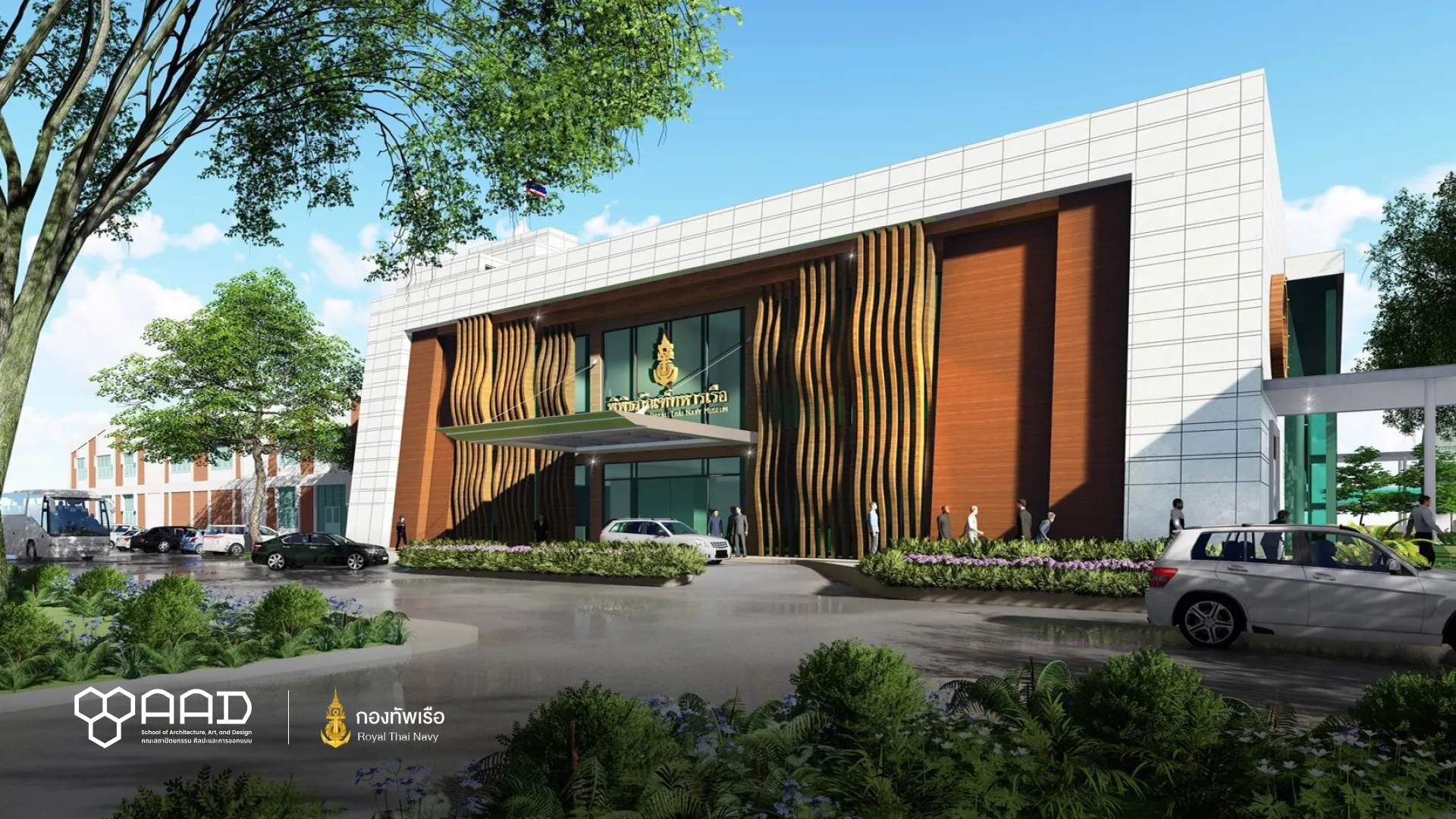
Royal Thai Navy Musuem
Current Royal Thai Navy Museum

Naval Museum is a special type of museum, established for collect and preserve of valuable ancient and historical items and places, that related to the Navy. Inside the museum, there are lots of naval historical information such as naval battles in the past, including the weapons used during that time. Furthermore, there are many ancient warship models such as the Royal Barges commissioned during the era of King Rama the Fifth, and the most interesting H.T.M.S. Matchanu.
New Royal Thai Navy Museum

The Royal Thai Navy is determined to enhance its relationship with the citizen through by transforming its museum into a hub for learning about maritime battles history. Located on the Issaraphap Road, where the Naval facilities are concentrated, the museum is set to renovate the entire experience to encompass everything from the all spaces and exhibitions to the overall visitor experience, with the goal of establishing a fresh environment for citizens to engage with the navy.
Royal Thai Navy Museum's challenges
A fewer visitors, A fewer incomes.
How can a museum survive financially?
Thai museums are struggling with popularity among locals. Many have only permanent exhibitions, leading to limited appeal for recurring visitors. Additionally, the exhibitions lacks of well-crafted curation, resembling storage for antiques, and later lead to a attraction deficit and reduction of engagement.
Many museums in Thailand are treated as a
“Storage for Antiques”
Unlike many popular museums in Thailand that generate higher profits through diverse exhibits and activities, the Royal Thai Navy Museum operates differently. They only rely on a single permanent exhibition and depends on support from donations and government funding, which falls short to cover future expenses.
Research Method
Objective
The research objective is to gain comprehensive insights from both internal and external perspectives, encompassing individuals within the organization, users, related entities, and communities. The focus is on conducting qualitative exploration to empathetically understand the people within the ecosystem.

Participant Recruitment

We conducted the interviewing by using Guerrilla interviewing using involves approaching people in public spaces to gather their perspectives. We conducted interviews by actively seeking potential participants near well-known tourist attractions within a 5km radius of the museum, targeting individuals from diverse demographic backgrounds.
Interviews Topics

The key actors are the visitors, and unraveling their motivations is pivotal in defining their goals. By integrating the Product-Service System methodology, we transcend traditional design thinking. This approach, enriched by PSS principles, reveals their mental models and behaviors of visitors through qualitative studies and interviews. The insights will enable the crafting of a design concept, facilitating the development of a museum service system that seamlessly caters to diverse visitor needs and aligns with their evolving expectations. The adoption of PSS principles is integral to shaping an enhanced museum experience, promoting sustainability and innovation throughout the visitor journey.
Findings
Stakeholder Mapping - Understand ecosystem

In developing the new system, defining all the interactions and relationships among the individual stakeholders ,will result in resource optimization based on product function. Our research involves the exploring of potential stakeholders within the ecosystem to identify opportunity and to configure their relation.
User's insights

Most students find history boring. Following interviews, it was discerned that the historical museum faces a notable challenge. Specifically, individuals lacking an interest in history may perceive the museum visit as unattractive. Conversely, museums in Thailand spotlighting the pop-culture are more attracting to the younger demographic. Visitors, particularly those from foreign locales, may include a historical museum visit during their exploration of other tourist attractions just to engage with the museum not content.
Students visit the historical museum only just to finish the work that they got assigned from the school.
Another important target group are families, particularly those with children who seeking quality time together. Museums are perceived as spaces where kids can learn while being entertained. However, the reality is that although children may find exhibits fascinating, they often looks for more interactive content and activities.
Parents love to take their kids to the museum to participate in the activities and would like them to learn something new and interesting.

The Royal Navy aim to make the museum be a center of learning and foster the collaboration with community to create circular economy
SWOT Analysis - Understand organization's context
Organization also play crucial part in deliver the service. We have to understand the context of the organization. Conducting SWOT Analysis will help identifying and assessing internal and external factors that impact the PSS's development, implementation, and success. This analysis aims to leverage strengths, address weaknesses, capitalize on opportunities, and mitigate threats, providing valuable insights for strategic decision-making and optimizing the design and delivery of the integrated product and service offering.

PEST Analysis - Understand related trends
Apart from the user and the organization, trend or the environmental also affect the ecosystem as well. We use PEST Analysis to evaluate and understand the external factors that could impact an organization, project, or business. By identifying and analyzing these factors will help us gain insights into the external environment, anticipate potential opportunities and threats, and inform strategic decision-making. The goal is to identify opportunities and threats in the external environment, aiding strategic decision-making and enhancing the overall effectiveness of the system design.

Persona
After conducting wide ranges of ethnographic research then to move over to the ideation, we defined and organized the data according to sets of shared attributes to formulate into a personality type or Persona. This collection of persona represents the target users for the project to frame the opportunity space and focus on for building the concept.

Insights & Opportunities Summary
Exciting Attraction
Visitors are looking for more than one attraction but currently, the museum is displaying only permanent exhibition that also lacked of well-curating.
More than museum
The museum contents are attracting only the people who interested or have something to do with history. To attract more people, museum need to be more.
Prime Location
Museum located in the heart of various tourist spots and also have fascinating architecture and space to be utilized.
Diverse Experts
Both the navy and surrounding communities have variety of expert in many fields.
Circular Economy
Museum aims to achieve make contribution to the society. Surrounding communities are historical-valued and looking forward to collaborate.